Blog Invitation

Blog Invitation

Register -Become a Follower

Friday, April 26, 2024

Oxymoron Part 2


I spent the whole night thinking what other oxymorons I can write here ...  just to drive home a point. 

Just like idiomatic expressions ... oxymorons can be CLEARLY CONFUSING (hey guys ... if you are not following you almost missed the capitalized word is another example of oxymoron - a phrase that consists of two ill-matched words ... very uncomplimentary with each other ... sounding discordant in every way. Confusing is a baffling puzzle ... and using clearly as an adverb to describe confusing seems poles apart.

Clearly confusing means - Malinaw pa sa tanghaling tapat that the situation lacks clarity of meaning ... causing confusion and perplexity. 

Here are other oxymoronic examples:

1. BIG BABY - babies are supposed to be small ... and in this oxymoron ... big was the adjective ... used to describe the baby. At first glance ... the words seemed at odds when placed side by side ... but after critical thinking, it makes perfect sense - a big baby - is a phrase coined to mean an adult that is prone to immature behavior associated with babies ... like crying or temper tantrums.

2. FULLY EMPTY -is another example.  Are you crazy? How can it be FULL when it is almost EMPTY a novice asked ... because she was confused about what its literal meaning is all about? But fully empty here means ... completely empty. Do you get the drift?

3. PRETTY UGLY - I always hear this oxymoron that pairs words that contradict each other. Small kids use this ... when they start describing somebody as pretty ... but at the end add the word ugly as a punch line ... or as an afterthought?

Pretty ugly means someone has a great figure and a sexy body ... but she has a face ... only her mother could love. In Tagalog sila yong mga hipon - maganda ang katawan ... pero ang mukha ... matatakot ka.


UP! - BINI x BGYO (Music Video)

Thursday, April 25, 2024

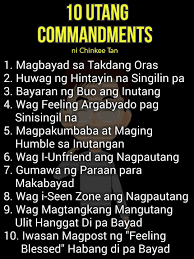
Utang Meme

I was browsing the internet marami na rin palang mga utang memes na matagpuan dito. Here are some pangungutang reminders to live by... na dapat isapuso natin at gawing gabay sa pagtahak natin sa buhay.

1


2. 

3.


4.

Huli Ang Pagsisisi


Walang happy ending sa Nangungutang at Nagpapautang. Pakinggan ang kanilang mga himutok.

NAGPAPAUTANG: Ang mali ko lang ... ay naniniwala akong MAGBABAYAD ka

NANGUNGUTANG: Ang mali ko lang ... ay naniwala akong hindi mo ako SISILINGIN.

Utang Na Loob ... Huwag Kang Mangutang!


Bakit kasi utang ng utang ka ... kung alam mo ... deep in your heart na hindi ka makabayad. Hindi ninyo ba kilala ang inyong mga sarili? Hindi mo alam na kung mangutang ka ngayon ... para ka na ring kumuha ng martilyo at ipukpok sa ulo ninyo?

You know pretty well na kung mangutang ka ... come hell or high water ... maniningil talaga yan.  Hindi man lang ba sumagi sa isip mo yan? Not unless wala ka talagang intensyong magbayad ... at tuwang-tuwa ka pang nangutang dahil wala naman sa bokabularyo mo ang magbayad.  Ipinag-dasal mo pa na sana ma-untog ang ulo ng nagpautang sa iyo at magka-amnesia siya ... at presto ... you are free as a bird at forgotten na ang mga utang mo. Ganoon na ba ang bagong uso at kalakaran ngayon?

Money does not grow in trees na ipikit na lang ng nagpautang sa iyo ang mata niya ... at hahayaan niya na lang ikaw kung kailan ka magka-konsiyensiya at magbayad.

Hindi mo tatay o kuya ang inuutangan mo ... at panatag talaga ang loob mo na maintiendihan ka niya? Napaka-entitled  mo naman na basta na lang kalimutan ng nagpautang ang hard-earned money niya na inipon pa niya sa pagtitipid at pagbudget  ng mabuti sa kanyang pinagiingatang pera. 

How convenient na ikaw pa ang magdesisyon kung magbayad ka o hindi.  Ikaw pa ang may ganang magalit kung sinisingil ka. At ilang beses ka na bang nagsisinungaling ... mapa-alis mo lang sa harap mo ang pesteng dating kaibigan na akala mo ay kaibigan mo ... yon pala ay araw-arawin ang pagdalaw sa iyo ... na parang may taning na ang buhay mo.

At palagi ka na lang na-stress. Naging magulatin ka pa at konting kuskos lang akala mo ... yong taong maniningil na ang nasa likod mo. At nakikita mo ba ang sarili mo ... na tago ka ng tago ... sisilip sa bintana bago umalis ... at lingon ng lingon ka kung nasa labas na. Pag gabi hindi ka makatulog ... at kung araw naman hindi ka maka-focus ... at lutang na lutang.

Sino ba ang pinagtaguan mo ... ang taong nagpautang sa iyo o ang sarili mo na parang hindi mo na kilala?  Wala ka nang freedom ... tinalo mo pa ang mga bilanggo ... nasa labas ka nga ... pero tinalo mo pa ang may parusang life imprisonment ... kasi wala ka nang peace of mind ... bawat galaw mo may nakaambang panganib at peligro - kesyo baka pikon na pikon na ang nagpautang ... at baka mag-run amok or mag-hara kiri ... or ipa-barangay ka dahil wala kang pakialam sa mga dapat responsibilidad mo.

Tanongin nga kita: bakit napilitan kang nangutang? Dahil ba ito sa kayabangan mo ... na nakita mo lang na nagpaBoracay ang kapitbahay ninyo ... aba ayaw mo talagang magpatalo. Ano sila lang ba ang may karapatang magbakasyon?

Dahil ba ito sa kaibigan mo na may bagong Ipad PRO and Air Model ... at gusto mo lang mapatunayan an kung ano ang kaya niya ... kaya mo rin? O ayan nagka-letse-letse na ang buhay mo dahil sa pangungutang ... hindi mo ba tinanong ang sarili mo na kung hindi ka lang mayabang ... sana wala kang ganyang problema sa ngayon?

Isip-isip lang mga tol. Why do you have to keep up with the Joneses kung hindi mo naman kaya?

Wednesday, April 24, 2024

Idiomatic Expression Of The Day

 Let's start using idioms or idiomatic expressions when we write. When idioms are used, it add color and texture to language by creating images that convey meanings beyond those of the individual words that make them up. An idiom can be very colorful and make a 'picture' in our minds. It also shows the writer's familiarity with English. When you want to make your writing sound more conversational, including idioms can give your writing a more relaxed tone.

Idioms allow us to say a lot with few words. Idioms amplify your messages in a way that draws your readers in and helps awaken their senses. It adds dynamism and character to otherwise stale writing. They make your writing less monotonous and your readers will think that you are smart and knowledgeable. All the while ... you only clothe your writing with elaborate idioms to create an impact... saying too much with less. 

To perfect your English, you really need to become confident in using idioms and knowing the difference between breaking a leg and pulling someone's leg. So the idiom of the day is:

IDIOM: Sins of Omission and Commission

MEANING: The idiom "Sins of Omission " means not doing what is right or failing to do as instructed. As a Catholic, if you refuse to love your neighbor ... or you failed as instructed to feed the hungry ... or give water to the thirsty ... or clothe the naked ... whatever you are deficient and seemed lacking in your love of your neighbor falls under this category.

On the other hand ... Sins of Commission are those sinful actions you proactively do. Lying to your teeth ... or stealing your parent's money falls under this genre because you commit these sins regularly and habitually.

To contrast the two ... in a sin of omission ... you choose to OMIT or not do what is right ... while in a sin of commission, you opt to COMMIT or do what is not right. While sins of commission are often ACTIVE, BLATANT, and DELIBERATE —transgressing a known law or command ... sins of omission can be PASSIVE and COMPLAISANT. A sin of commission is a WILLFUL act ... while sins of omission are just your relaxed WILL and your stubbornness to carry out what is instructed and was told of you.

ORIGIN: The theology behind a sin of omission derives from James 4:17, which teaches "Anyone, then, who knows the right thing to do and fails to do it, commits a sin." Its opposite is the sin of commission, i.e. a sin resulting from an action performed

USING IT IN A SENTENCE:  If I know that Johnathan will lie to his teeth to protect himself and I did not stop him ... or I keep mum about what I know ... it is a prototype example of sin of omission. If I helped him lie and even volunteered to be his witness ... it would be a paradigm and a classic example of sin of commission.

Idioms In Tagalog

 One of my friends asked:  "Are there idiom equivalents also  in the Tagalog language?" Of course, there are.  Katulad ng idioms sa English, ginagamit ito para tumingkad ang paglalarawan ng mga bagaybagay at para mapaigting  at matalinhaga ang takbo ng usapin o pagsusulat.

And just like in English ... ang kahulugan ng mga "sawikain or idioms" ay magkaiba sa literal meaning ng mga salita. Sa madaling salita ang mga sawikain don't mean exactly what the individual words in it say. Tandaan natin ... ang figurative meaning ng mga sawikain ... is different from its literal meaning


Huwag kang baliw!  Kung may nagsabi sa iyo na makapal ang mukha mo ... huwag ka nang magpaligoy-ligoy pa.  Tanggapin mo na ang katotohanan na "kapalmuks ka".

Huwag mo nang uto-in ang iyong sarili at kumbinsihin ang mga nakarinig na "siguro siabi niyang makapal ang mukha ko ... dahil makapal lang talaga ng make up ko"  ... or budolin ang mga madlang people na " what he meant sa sinabi niya na makapal ang mukha ko ... he is referring to my pimples at mga tagihawat ko.  Dumami kasi ang kanilang population ... pwede na gawing popcorn."

Ulol! Aminin mo na ... The figurative meaning was that you are SHAMELESS ... at huwag ka nang magtago pa sa literal meaning ng idiom ... na ibig sabihin ay ... THICK FACE.

Ikaw talaga ... pati ba baman make up at tagihawat ginamit mo nang palusot.

Flag Counter

free counters

Be A Follower

Be A Follower

Blog Of The Week

Blog Of The Week

Blog of The Week

Blog of The Week

Revolver Map

Powered By Blogger

Search This Blog

Visitors Stats Today

  • …

    Posts
  • …

    Comments
  • …

    Pageviews

Today Is

Calendar Widget by CalendarLabs

World Time

About Me

Wretired writer, Malayang Free Thinker, Probing Blogger, Disenteng Dissenter, Tempered temperamental, Liberal-Conservative, Grammar and Syntax Police, Pageant Connoisseur, Hibiscus Collector

Back To Top

”go"

Labels

Ang Pambansang ATM: Hero ng Pamilya o Sira-Sirang Machine?

  Sa dakilang kultura ng Pamilyang Pilipino, may limang pangunahing Social Class: ang Mayaman, ang Middle Class, ang Mahirap, ang Isang Kahi...

Popular Posts